JOSÉ RAMÓN AMONDARAIN. More Than Living
09 Sep 2026 - 03 Oct 2026
It is astonishing that we humans can look at a simple stone and imagine the shape of an arrowhead within it. The ability to construct an image in the mind and transfer it, by hand, into the external world, together with language, has been our great comparative advantage. Homo sapiens—the human being who brought us to where we are today—emerges from a prehensile activity: it is the subject who grasps. As heirs to the primates, we grasp, separate, hold, control, construct, calculate, measure, compare, and organize. We are a species with a nervous system of extraordinary potential that chose the technical path as its mode of development: the manipulation and construction of forms.
This profound interconnection between the hands and the brain is evident in the Penfield homunculus, in which the different parts of the body are represented according to the amount of neural resources they require. In this representation, the face and, especially, the hands stand out disproportionately. The brain not only maintains a precise record of the position of our hands; it also possesses an extraordinary awareness of the posture of the body as a whole, at every moment and in every context.
In the mid-1960s, Bruce Nauman documented on video a series of actions in which he explored different, successive bodily positions. In his work, “postures” become a tool for disarticulating reality through proprioception, the sense that allows us to perceive the position, movement, and action of our body in space without having to rely on sight. In Wall Floor Positions, the artist arranges a series of bodily configurations that articulate his body in direct relation to the architectural surfaces of the studio—the walls and floor—adopting deliberately uncomfortable or forced positions that reveal the operative and processual nature of the action.
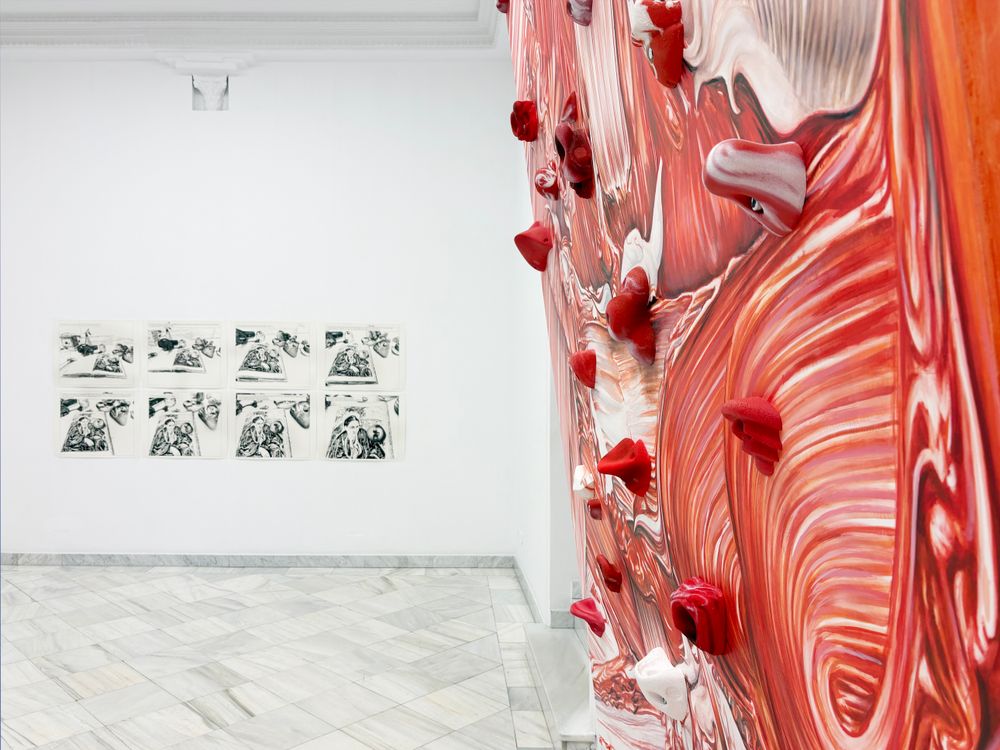
Similarly, on climbing walls, the practice of climbing involves the systematic rehearsal of specific bodily patterns. Static positions, or locks, require the climber to execute a movement and hold it for a few seconds before continuing. This momentary pause generates a kind of bullet time: a suspended instant in which the body concentrates the past, present, and future of the gesture, much as Degas did when he managed to show, within a single movement, what has just happened, what is happening, and what will happen immediately afterward.
This expanded perception of the instant finds an echo in the position most widely accepted by science regarding the so-called splitting of time, according to which physical time does not flow in itself, but the brain generates the sensation of flow as a functional mechanism.
The body and brain process information and anticipate outcomes before conscious thought comes into play. Thus, thanks to the mechanisms of the predictive brain—which combine memory, the simulation of possible futures, emotion, and learning—phenomena such as premonitions, intuitions, inspirations, hunches, epiphanies, and sudden moments of lucidity can be explained.
These revelations awaken in the artist a desire to elaborate: calculations and projections that will inevitably be betrayed, but that are necessary to engage with the dynamics of desire. The “climber’s technique”, a method that facilitates planning when one does not know where to begin, offers a way of organizing anticipatory information. This technique makes it possible to define a final objective and the intermediate stages necessary to reach it. Like mountain guides, who first visualize the summit and then trace the route downward, this method begins with the final objective and identifies, step by step and in reverse order, the preceding states until it reaches the starting point.
In the realm of art, however, this teleological model enters into crisis. The objective to be reached becomes a kind of MacGuffin: an operator that keeps the process open and produces a constant sense of insufficiency and incompletion. This is a productive condition that enables becomings, displacements, and reconfigurations of meaning. A constellation of signs thus sets out in pursuit of a desire that, if only for an instant, manages to seep into the folds of space, into its hidden, fleshy interstices.
Desire no longer remains on the surface, as it did in the Baroque, but manifests itself in the thickness and movement of images. Indeed, we allow ourselves to be explored by an infinity of dimensional spaces and by a world of multiple relations. We live through a decentralized, tentacular mode of thought, with an inexhaustible number of connections, and we witness astonishing discoveries, such as the scientific community’s revelation of certain mysteries of nature.
One example is Physarum polycephalum, whose name literally means “many-headed slime,” nicknamed “blob” after the film The Blob. It is a single-celled organism with no mouth, stomach, or eyes, yet it is capable of detecting and digesting food. Nor does it have arms or legs, yet it can move and double in size within twenty-four hours.
Scientists have concluded that, despite lacking a central nervous system or a brain, the blob can learn from experience, transmit knowledge, and modify its behavior accordingly. It can organize itself, respond to its environment, and find solutions that do not conform to human logic.
A Japanese study conducted in 2010 showed how Physarum polycephalum was able to map out a network comparable to the railway network of Greater Tokyo. For the experiment, researchers used a translucent plate that reproduced the geography of Tokyo and its surrounding areas through variations in light intensity, placing food sources—oats—at positions corresponding to the main urban centers. The result was that the this single-celled organism mold designed a network of tubes remarkably similar to the city’s railway network, which had been developed over several years of human planning. This experiment reveals that life does not thrive through isolation, but through connection.
The blob advances like life itself exploring blindly
making mistakes retreating trying again
It learns not through ambition but through contact
Memory is not located at the center but in the path
The blob whispers to us that perhaps intelligence does not consist in controlling but in adapting
that wisdom is not about moving quickly but about finding a sufficient path
While power demands productive lives the blob practices a sufficient life
The blob is a figure of anonymous becoming an impersonal preindividual life
Life does not need to be governed to be intelligent
It does not need consciousness to be intelligent.
When I think of the Physarum polycephalum, my mind returns again and again to Jackson Pollock’s drippings. There is something in that flow—in the artist’s bodily act of letting go—that turns the body itself into an instrument for generating patterns. In the absence of center and hierarchy, dripping unfolds a visual field without a focal point: a continuous web that expands evenly across the surface. In 1994, the scientist Richard Taylor conducted a study demonstrating that Pollock had created fractal networks in his paintings approximately twenty-five years before Benoît Mandelbrot published The Fractal Geometry of Nature in 1977. Taylor also observed that the fractal dimension of Pollock’s works increased progressively over the course of a decade, as the artist refined his dripping technique. Both the Physarum polycephalum and Pollock’s dripping function as rhizomes, as open systems, generating trajectories, multiplicities, and different relations of intensity understood as processes in the making.
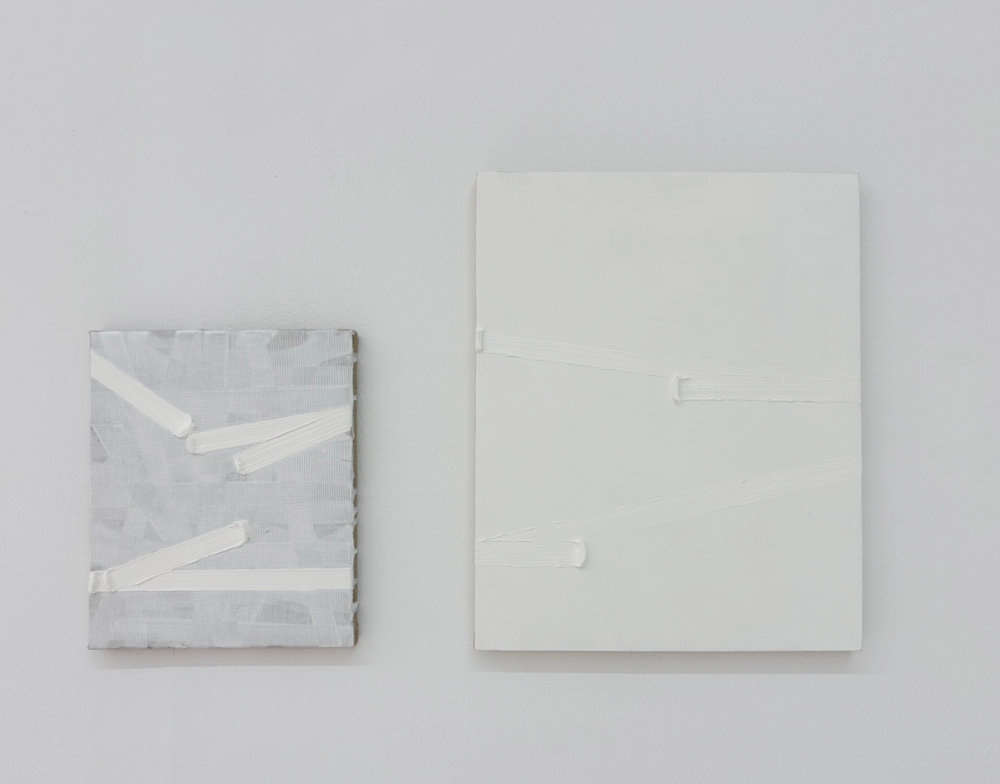
We might think of painting as an intelligent material, devoid of consciousness yet capable of experiencing the world without the need for self-reflection. Painting does not think like a subject, but it persists, remembers, and responds. It is an active material, endowed with history, agency, and a capacity for thought of its own, allowing us to imagine that forms do not originate solely in the present, but emerge from fields of memory that traverse time and space. In this way, painting might survive through a form of intelligence proper to the material itself, to its capacities, while painters could become a kind of tool—often caught on a hamster wheel by the sustained attention characteristic of a consciousness immersed in inertia.
Painting operates as a device for destabilizing previously held certainties, not so much through what it produces as through what persists within it. Its power lies not in the final result, but in the residue that survives intention, where the pictorial material no longer submits to an individual logic but responds to a transpersonal will. This will is not expressed through the painter; rather, it is actualized in the painting itself, understood as a site of inscription and enactment. In this sense, the painter is not defined by the act of painting itself, but by the framework of thought that sustains the practice. Recognizing that thought is neither autonomous nor originary, but one possibility among others, entails assuming a responsibility; and every desire for connection—with matter, tradition, or another person—necessarily entails responsibility.
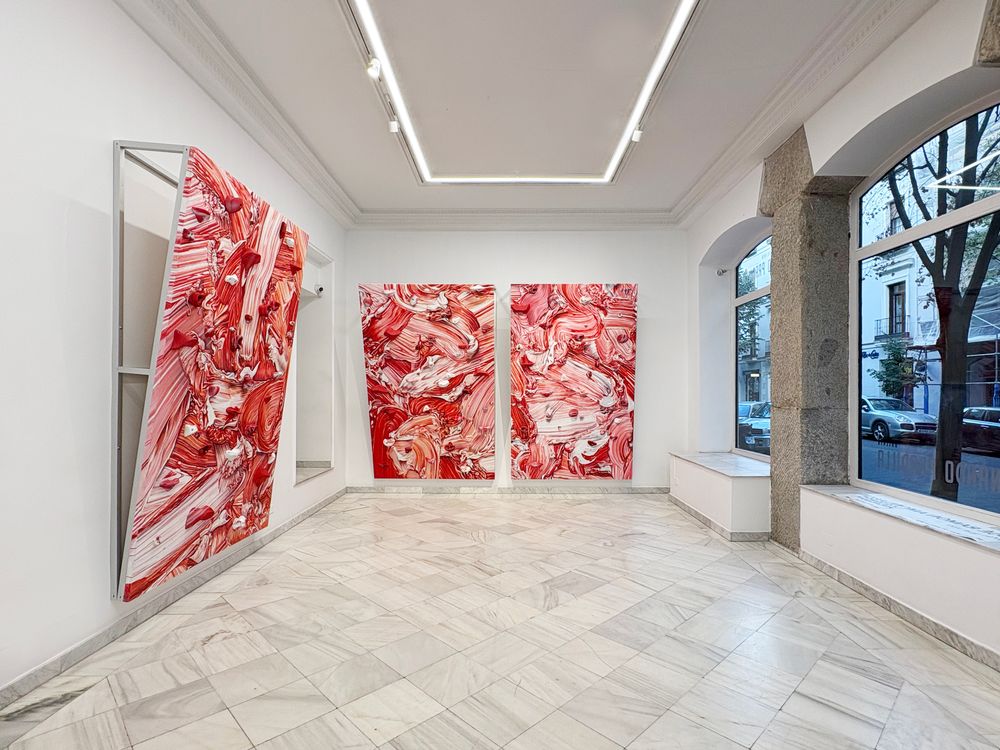
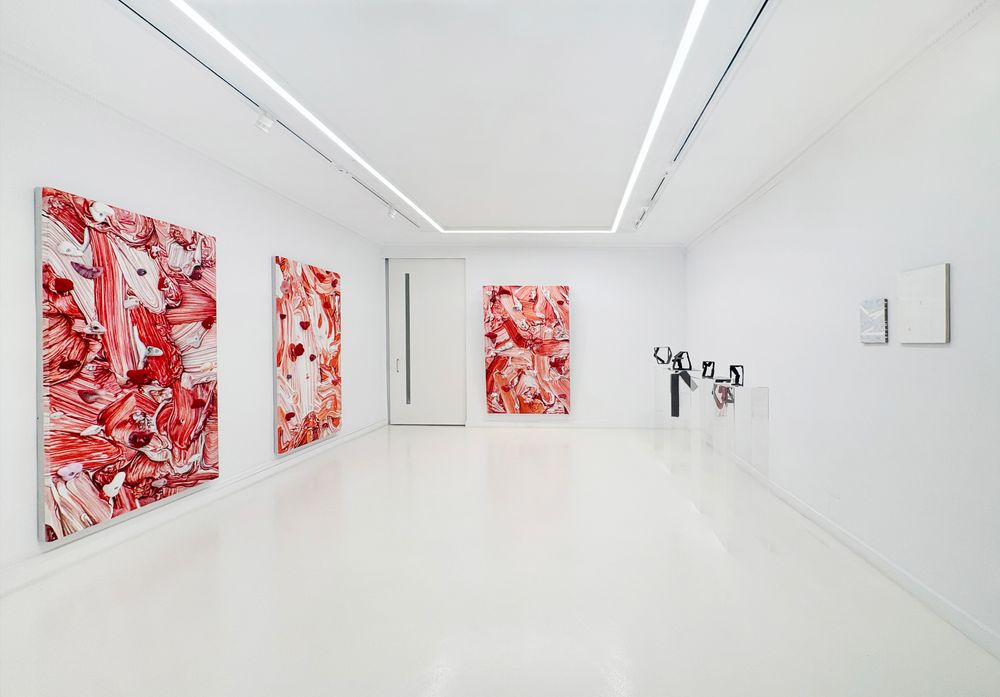
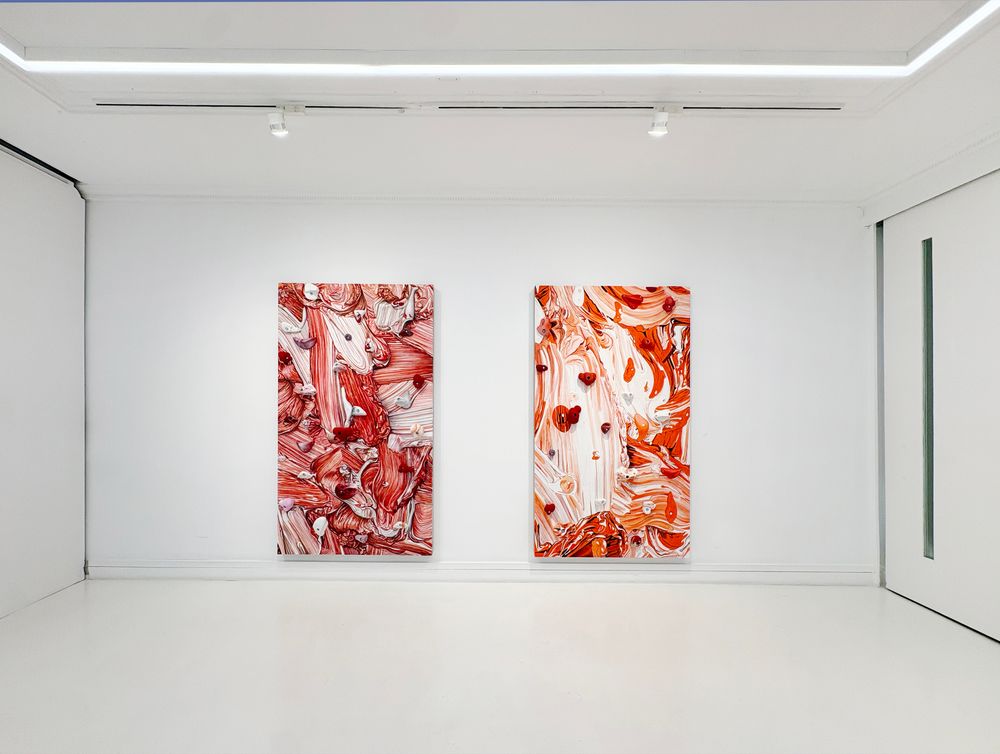
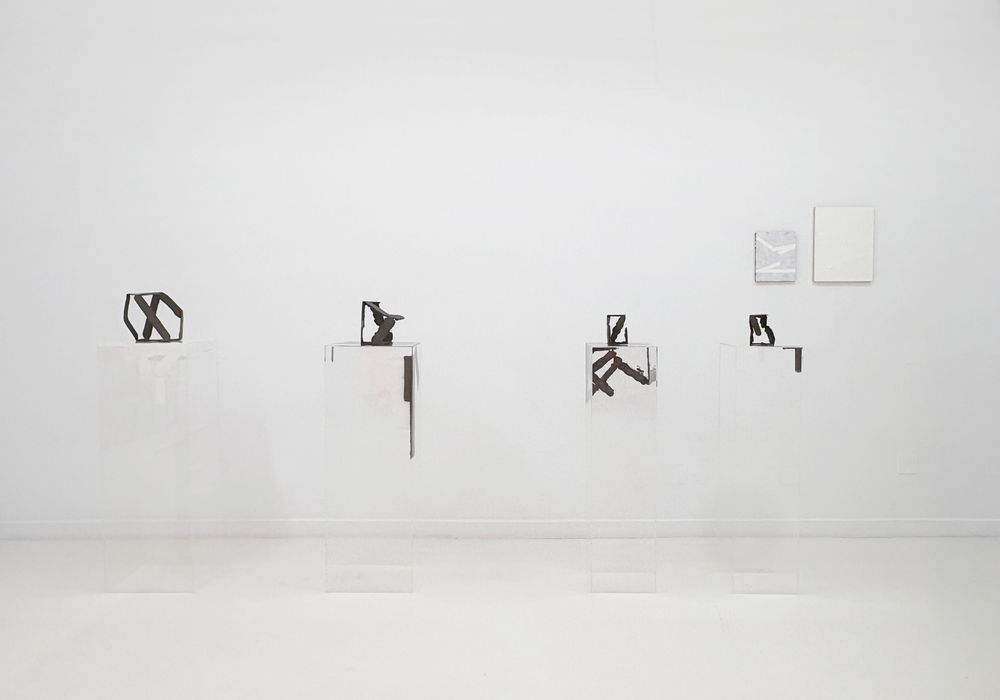
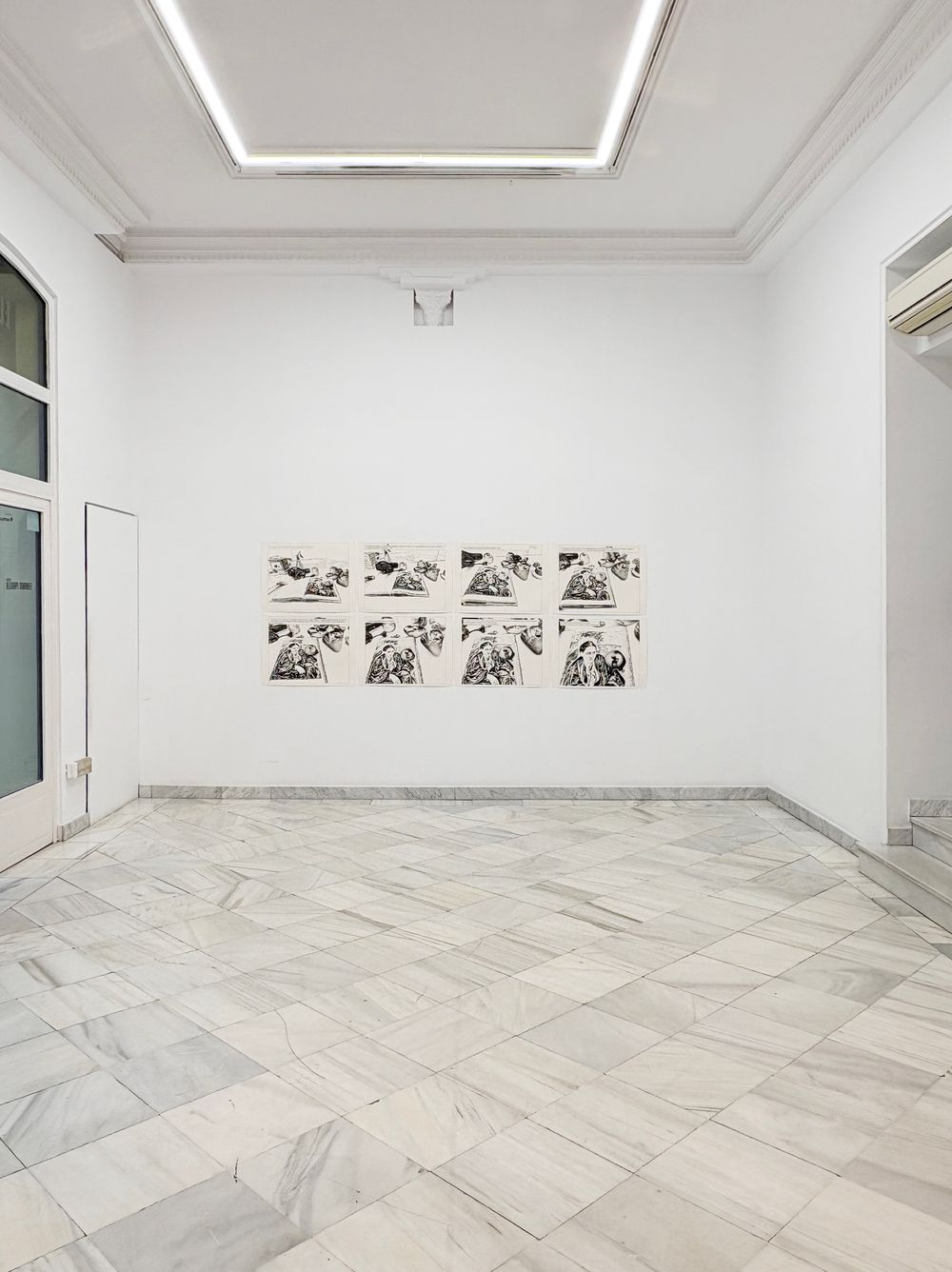
The works in the More Than Living project unfold as a choreography in which the viewer can move between different focal distances. As we observe in Titian, our vision often relies on peripheral vision, capturing imprecision because we cannot represent the world in its entirety. Peripheral vision does not seek sharpness, but rather a broad and diffuse perception in which the visible is sustained by indeterminacy. As we approach the work, almost grazing its surface, our gaze becomes concentrated and activates the fovea, that small area of the retina where visual definition reaches its maximum. This focusing creates fragments of attention, small focal points that allow us to explore the foreground, while at the same time transporting us to the scale of aerial views or a topographical survey, offering, without a doubt, a high-definition view of reality itself.
José Ramón Amondarain. 2026