Summer Group
14 Jul 2026 - 12 Aug 2026
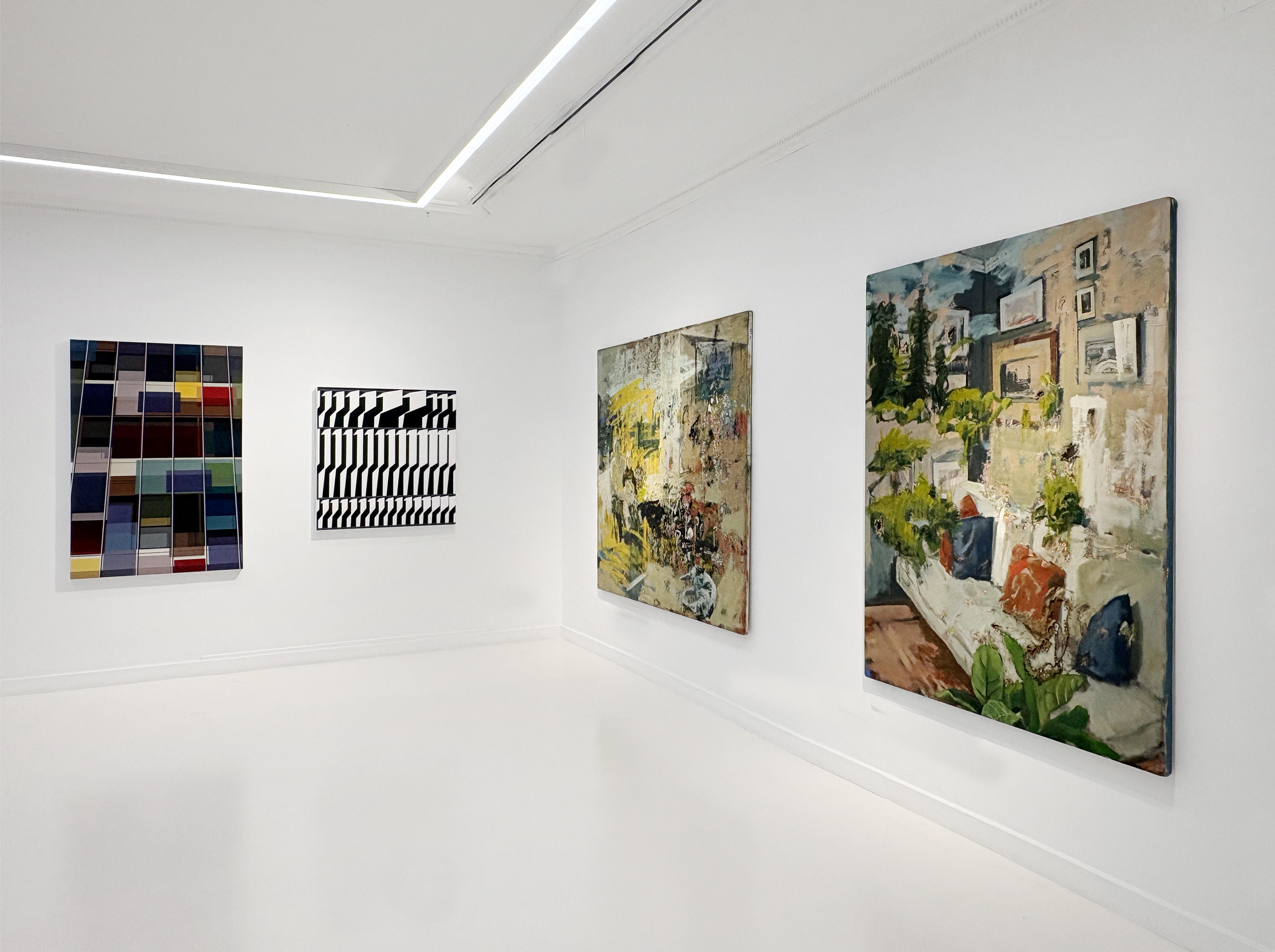
The Fernando Pradilla Gallery presents its summer group exhibition. This year, the show is dedicated to showcasing the work of some of our represented artists alongside guest artists exhibiting with us for the first time. The common thread connecting them is an exploration of the pictorial surface.
We encounter geometric proposals based on line, plane, and colour from Jorge Cabieses (Lima, Peru, 1971) and Hildebrando De Castro (Olinda, Brazil, 1957).
In his recent paintings, Cabieses surprises us by incorporating freer gestures, brushstrokes, and marks into the "hard-edge" geometry for which he is known. Throughout his various series, he has worked by appropriating images and supports—such as applying geometric patterns over Gobelin tapestries or onto pages from history books depicting academic works by classical painters.
Hildebrando De Castro pursues a similar line of geometric inquiry. For years, this artist has developed work based on field studies of building facades that catch his eye due to their structural characteristics. In this group exhibition, we present two paintings that pay homage to brise-soleil architecture—a construction solution championed by Le Corbusier, in which a system of facade louvers acts as a sunshade, protecting the building from the sun while directing light into the interior. In doing so, De Castro honors admired contemporary architects such as Herzog & de Meuron and Roger Diener. His paintings—featuring distinct colour planes or combinations of black-and-white forms—create a geometric, two-dimensional abstraction of the buildings' structural masses, imbuing them with a compelling optical dynamism.
Another line of inquiry is found in the work of two artists who round out this summer’s group exhibition: Vicky Neumann and Aurora Lario. Their work centers on the human body as a political site of representation. Vicky Neumann (Barranquilla, Colombia, 1963) paints domestic interiors that evoke an atmosphere of the past, hinting at the artist's childhood memories. The furniture, objects, and paintings adorning the rooms appear before our eyes as if worn away by time. Her technique relies on layering pictorial planes and dragging the paint across specific areas of the canvas. These "dragged" zones suggest a process of "erasing information," evoking the aesthetics of phantasmagoria and illusionism. The human figures depict young women sleeping or cradling babies in their laps, while a male figure appears seated in an armchair, observing the scene. The motif of the "picture within a picture" is also noteworthy; these domestic spaces are decorated with paintings typical of bourgeois interiors, such as landscapes and still lifes.
The layering of images and their unexpected juxtapositions have served artists—first within Surrealism and later in its successor, New Realism—as a means to prompt the viewer to reflect on the meaning of what is seen. Everyday imagery is rendered through painting, patching, and the use of fabric scraps. Vicky Neumann’s works thus become compositions incorporating cut canvases and fragments of other paintings, reconfigured on the canvas surface to generate new
interpretations of the visual experience.
In these series, where the body takes center stage, Aurora Lario (Madrid, Spain, 1967) returns to oil painting—a technique that has enabled her to explore the passage of time as it manifests on the skin. Although the work is figurative, the artist eschews fine detail in favour of broad brushstrokes and masses of paint that coalesce into abstract fragments. "Nudity always represents vulnerability. It is an image we all share, each through the lens of our own personal experience. From happiness to despair, human beings express emotion with their entire bodies, and nudity is the purest, most authentic, and most truthful way to do so," notes Lario. Her new body of work addresses themes such as femininity, eroticism, love, motherhood, violence, excess, aging, and death—subjects through which she revisits aspects of the human body that have fascinated her since the beginning of her artistic career.
Continuing with the theme of representing the human figure, we encounter the work of Ricardo Muñoz Izquierdo (Pereira, Colombia, 1985)—a visual artist who is also a prominent experimental filmmaker within the Colombian scene. His work combines scatology, violence, and autobiography to construct a unique form of surrealism, exploring audiovisual language, drawing, and photography. The pieces included in this group summer exhibition belong to his project Antropofagia psicotropical (Psychotropical Anthropophagy); in the words of curator Elías Doria, they constitute “a prototype of a bestiary, a system of thought, and a poetics of the mental realm. This category stems from the central premise of Oswald de Andrade’s 1928 Anthropophagous Manifesto, which proposed the critical devouring of the colonial canon as a means of creating an indigenous culture. Much like the Brazilian Tropicalistas—who, decades later, radicalized this notion by forging a psychedelic aesthetic capable of transmuting foreign influence into an exuberant identity—Ricardo Muñoz Izquierdo revisits this anthropophagous logic. However, he seeks not merely to digest the canon, but to fragment and reconstruct it within a hybrid reverie where the unconscious, acerbic humour, and the imaginative drive operate as transformative forces. Here, the tropics serve not as a geographical allegory, but as the key to a perceptual mechanism capable of revealing the monstrous and the sublime from an insurgent standpoint.”
In another area of inquiry, we encounter the work of Alejandro Sánchez (Bogotá, Colombia, 1981), whose practice reflects on globalization, unchecked capitalism, and free trade in the Americas. The pieces in this exhibition are part of his series Fantasmagoría (Phantasmagoria)—a pivotal project for the artist that addresses the use of colour as a tool of domination, the deconstruction of urban progress, and optical illusion. Sánchez appropriates the term "phantasmagoria" through the lens of Karl Marx, who used it to describe how the world of commodities conceals the traces of the human labour that produced them. Sánchez casts an optical veil over his works, stripping them of colour to encourage the viewer to confront an illusion. His pieces seek to question the veracity of archival images, demonstrating that history and the paradoxes of power depend entirely on the perspective from which they are viewed.
As art critic Christian Padilla notes, “Alejandro Sánchez experiments with tartrazine—a substance that artificially dyes drinks, candies, and even meats—transforming it into pigment and using the napkin as a substrate; this symbolic choice reinforces the link between his works and his inquiry into the construction of those economic empires. He uses these materials to create images that look back with nostalgia at the past of cities undergoing modernization—specifically, the flourishing Bogotá of the mid-20th century. Yet, what appears from a distance to be a hyper-realistic copy of vintage photographs reveals itself, upon closer inspection, to be a repeating topographical mountain pattern covering the entire surface. Thus, Sánchez’s painting becomes a hypnotic visual illusion, lingering as a ghostly image suspended between these two perspectives: from afar, the portrait of a nation building its progress by equating it with infrastructure and urban development; up close—reading between the lines—the landscape that constitutes true wealth is shown to be constructed and supplanted by an artificial dye, serving as an allegory for the colonization of national territory by multinational corporations.”
This group exhibition features two magnificent paintings by Juan Francisco Casas (Jaén, Spain, 1976)—a regular artist at the Fernando Pradilla gallery—showcasing large canvases from his recent project, La noche sexual (The Sexual Night). Inspired by Pascal Quignard’s book of the same name, these works explore the relationship between the represented and the real through the image returned to us by a mirror. Here, the images are kaleidoscopic, projecting a narcissistic reflection where Eros and Thanatos converge. The paintings—two large floral still lifes executed in oil and lipstick—present an eroticized image of a bouquet, drawing inspiration from the 17th-century works of Dutch artist Rachel Ruysch, to whom this series pays homage.
The summer selection is rounded out by three paintings by Natalia López de la Oliva (Tomelloso, Ciudad Real, Spain, 1998), a unique artist who blends the literary narrative of poetry with painting. Her scenes conceal stories of diverse characters, strange bodies, and beings with fluorescent eyes that gaze back as if from another dimensional reality. Her work embodies the intuitive ambiguity of someone observing the world from a kitchen window. A Fine Arts graduate from the Faculty of Fine Arts in Cuenca, she cultivates an anthropomorphic expressionism in which images and sensations dissolve across the expanse of the canvas. Driven by an honest narrative, her painting serves as a vehicle to convey her distinctive vision and understanding of the world. Her colour palette—marked by an expressionist touch—spreads across the canvas, creating contrasts of tone and form that speak directly to the viewer's subconscious, inviting them to make sense of the scene gazing back at them from the painting.